One whole house water filter. Clean water from every tap.
The Peka is positioned centrally at the property’s water connection and filters the water before it is distributed throughout the house. It removes what doesn’t belong in the water and leaves in what does. No electricity, no salt, no maintenance contract.
Complete systems from €2,799.–, including VAT and delivery.
The filter stages you need depend on your water. That is exactly what we will clarify beforehand.
- Reduced levels of microplastics, PFAS, heavy metals and pesticides
- Minerals remain in the water
- Innovative limescale protection without salt tablets
- Virtually maintenance-free
- Cartridge replacement in five minutes, without the need for a specialist
All filter components and filter media are NSF®-certified.
The line is currently busy
+49 3327-570-880I'll be available again tomorrow from 9 o'clock. Or you can arrange for us to call you back right here.
We’ll give you a call
A quick, no-obligation chat: our water experts will discuss with you whether the system is right for you.
Your data will be used solely for the purpose of processing your enquiry. Privacy Policy
One system. The best water throughout the house.
The Peka is situated behind the water meter, where it all begins. Everything that comes after that is filtered throughout the house: the kitchen, the bathroom, the utility room and the garden tap.
You don’t just buy a whole-house system on a whim. Almost always, the first question – even before considering the price – is: ‘What exactly am I getting into?’
Give us a call. We’ll take care of everything right through to installation.
All it takes is a four-minute phone call, a small bottle of water for the post office and a call to your plumber.
Your part
about 15 minutes
Two quick phone calls and a small bottle of water, which you pop in the post.
Our part
everything in between
Analysis, evaluation, compilation, delivery. Plus installation instructions and connection details for your installer.
One phone call, four minutes
Please leave your name, telephone number and a time that suits you. We’ll ring you back within one working day to discuss the key issues: how hard your water is, whether you’re the property owner, and whether there are any known contamination issues in your local area.
A small bottle of water, five minutes
We’ll send the test kit to your home. You simply fill it in and pop it in the post – the return postage is included.
The 360-degree water analysis
We carry out a comprehensive analysis of your water: for heavy metals such as lead, copper, chromium, nickel and aluminium; for iron, manganese and nitrate; for chlorine, fluoride and iodine; and for residues of herbicides, fungicides and insecticides. A single laboratory test rarely covers so many parameters at once, and it is precisely this comprehensive analysis that we need in order to recommend the right filter stages for you.
The analysis costs €80.–, including postage, and if you decide to go with Peka, we’ll deduct the cost from the purchase price. So you’ll only pay for it if you don’t end up buying from us. In that case, the results will still belong to you. You don’t need to place an order; our customer service team will take care of that after the consultation.
Your Peka, tailored to your water
The Peka system is modular. The assessment will determine which filter stages are appropriate for your needs and which you can do without. You will receive a ready-made recommendation with a price, not a price list that you have to sort through yourself.
Installation, in half a day
To do this, simply commission a specialist contractor of your choice. We will provide them with all the necessary documentation and connection details; for them, the connection is a routine job, and they can contact us at any time if they have any questions. That’s all you need to do.
And then what? After that, you won’t hear a thing from Peka. No maintenance appointments, no salt tablets, no electricity. Just the occasional cartridge, which you can easily change yourself if you like. It takes about five minutes.
A domestic water filter that retains the minerals in the water.
Anyone wishing to filter their tap water thoroughly soon finds themselves faced with a dilemma. The methods that reliably purify the water remove absolutely everything from it. The methods that leave the water as it is remove hardly anything.
Reverse osmosis
- Takes out
- almost everything, very thoroughly
- Will it cost you
- the minerals as well. Plus waste water, the tank and electricity
Water softener
- Takes out
- water hardness
- Will it cost you
- Calcium and magnesium, swapped for sodium. A sack of salt in the cellar
Backwash filter
- Takes out
- Sand, rust, particles
- Will it cost you
- nothing, but it only solves this one problem
Peka
- Takes out
- Microplastics, PFAS, heavy metals, pesticides, chlorine and more
- Will it cost you
- nothing that belongs in the water
Peka uses PI technology and over 20 types of mineral ceramics. It filters out what does not belong in the water, whilst retaining calcium, magnesium and trace elements. No electricity, no waste water, no salt.
How osmosis and PI technology differ
Filtering is one part of the process. The other is regeneration.
In nature, good water is not produced in a plant, but along a path. Rainwater seeps through layers of sand, gravel and rock. As it does so, it loses what does not belong in it and absorbs what makes it rich in minerals. Eventually, it emerges from the mountain as spring water.
This is exactly the path your tap water takes through the Peka. In the final stage, it flows through more than 20 mineral ceramics, which are modelled on natural layers. This is the part you wouldn’t expect from a water filter, and the reason why we talk about regeneration rather than just filtration.
How PI technology worksThat is why the Peka is not a substitute for a backwash filter on the property connection, but something different: the former traps sand and rust, whilst the Peka takes care of what you cannot see.
What gets trapped in the filter
- Microplastics remains in the filter
- PFAS reduced
- Heavy metals, such as lead reduced
- Pesticides and herbicides reduced
- Chlorine and chlorination by-products reduced; trihalomethanes by 99.2 per cent
- Hormone and drug residues reduced
- Sand, rust, mud, particles larger than 1 µm held back
- Calcium, magnesium, trace elements remain in the water
Trihalomethanes are formed when chlorine in water reacts with organic compounds.
That is the whole idea behind PI technology: the filter stages remove the substances that do not belong in the water. The minerals that make good water remain in it.
Innovative limescale protection without salt tablets
Hard water leaves limescale deposits wherever it gets warm: in the boiler, in the washing machine, in the pipes. Traditional water softeners solve this by means of an exchange. They remove the limescale and, in return, add sodium to the water – the main component of table salt. That is why there is a sack of salt in the cellar.
Peka’s limescale protection module takes a different approach, combining two methods in a single module. The formulation is produced in-house.
The first method removes some of the limescale
It binds calcium and magnesium, converting the dissolved lime into carbon dioxide and water in the process. This amount is not replaced by anything else. It disappears without a single grain of salt being added.
The second method neutralises the rest
At tiny starting points, dissolved calcium coalesces into microscopic crystals that float freely in the water. Limescale that is already present as a fully formed crystal no longer has any reason to attach itself to the inside of a pipe or a heating element. Nature has always worked this way: mussels and corals build up their calcium carbonate at precisely such starting points.
The result: Some of the limescale is removed from your water; the rest remains in it without causing any harm. No sodium, no added salt, no electricity. And what doesn’t end up in the water: no chlorine, no phosphorus, no sodium, no acids.
And what do you notice about it?
Soft water feels different. Limescale combines with soap to form a fine film, and it is precisely this film that remains when the water is hard: on the skin, in the hair, and on the towels. As the water becomes softer, this film also becomes less noticeable. Most people first notice this when showering and washing their hair.
The usual route to achieving this involves sodium. A water softener replaces calcium with sodium, the constituent of table salt. For every degree of German hardness it removes, around 8 milligrammes of sodium are added to each litre.
At 20 °dH, that is around 165 milligrams, and the limit set by the Drinking Water Ordinance is 200. That is why such systems are usually set to a specific residual hardness level. Anyone watching their sodium intake or preparing infant formula will want to keep an eye on this figure.
Peka is taking a different approach. It removes some of the hardness and neutralises the rest, without adding a single sodium ion to the water. On top of that, the intensive filter reduces the chlorine. Softer water from every tap, without you having to pay for it when you drink it.
Calcium and magnesium remain in the product, and that is intentional. The Peka removes some of the hardness and reduces the rest. If you want soft water in the traditional sense, a water softener is the right choice. Just let us know when we speak, and we’ll save you the hassle.
How noticeable the difference is depends on your tap water. The harder it is, and the more of that hardness is in the form of carbonates, the more noticeable the effect. You’ll first notice it in your kettle and on your taps. We’d rather not give you a figure that doesn’t apply to your water at all.
Will a domestic water filter fit in my home?
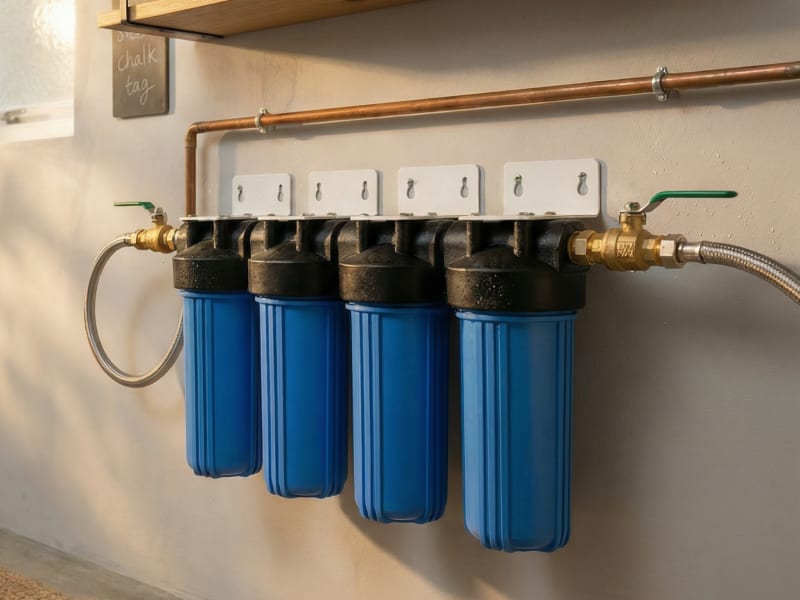
In most houses, yes. The Peka is installed in the main pipe directly behind the water meter, usually in the cellar or utility room. The amount of space you have on the wall does not determine whether it is possible, but only how the modules are arranged.
Flexible installation: three ways, the same system
Four modules, three configurations. The installer will decide which one is best for you based on the space available on site. Diagram, not to scale.
-
Flexible installation Side by side, in groups or as a column. A clear wall measuring 1.20 m is ideal, but not essential.
-
Installation by your specialist contractor Your plumber will receive all the documentation he needs for the connection from us.
-
Half a day’s work For a specialist firm, the connection is routine.
-
Let’s clarify three things first How hard your water is, whether you are a homeowner, and whether there are any known pollution issues in your local area.
Installation will be carried out by a specialist contractor of your choice. We will provide them with the installation instructions and all the connection details so that they know what to expect, and they can contact us at any time if they have any questions. For a specialist contractor, the connection is routine work, usually taking half a day.
Technical specifications (Peka 10)
- Flow rate
- approx. 20 to 30 l/min at a minimum of 4 bar
- Pressure loss
- approx. 0.5 to 1.0 bar
- Dimensions (H × W × D)
- 41 × 120 × 22 cm with four filters
- Diameter of the housing head
- 195 mm
- Weight
- 17 kg empty, 22 kg with cartridges
Technical specifications (Peka 20)
- Flow rate
- approx. 45 to 60 l/min at 4 bar
- Pressure loss
- approx. 0.5 to 1.0 bar
- Dimensions (H × W)
- 62 × 117.5 cm with four filters
- Diameter of the housing head
- 185 mm
- Weight
- 20 kg empty, 32 kg with cartridges
- Designed for
- large buildings, multiple residential units, commercial premises
Your water determines which filter stages you need
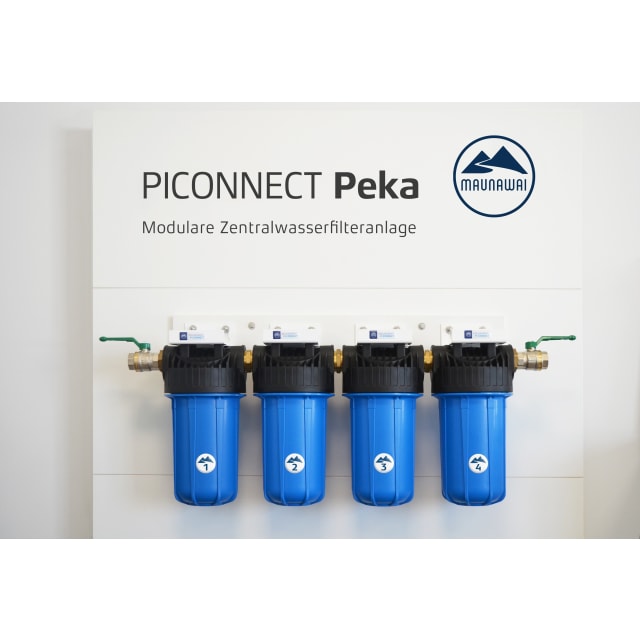
The Peka has a modular design. Four levels are standard:
-
1
Primary filter Traps sand, rust and suspended solids, and protects the subsequent stages.
-
2
Intensive filter The activated carbon stage. This is where microplastics, PFAS, pesticides and chlorine are retained.
-
3
Limescale protection Removes some of the hardness and binds the rest, without salt.
-
4
MAUNAWAI-PI Over 20 mineral ceramics. The stage that regenerates the water.
And if your water needs more
Depending on the region and the building’s origin, additional modules may be required. Most houses do not need any of them.
Your own well? Then you’ve come to the right place. The Peka is designed for mains water and well water, and the modules shown above are specifically for well water. The analysis will tell you what you need. Without it, we’d just be guessing – and we don’t do that.
That’s why we tailor your Peka system to your specific analysis rather than offering a standard package. We analyse your water and advise you on which stages are necessary and which you can do without.
You can see how much each replacement cartridge costs and how long they last below, under ‘Running costs’.
Arrange a call-backWhat to look out for when choosing a domestic water filter
The systems available on the market differ more than the product photos might suggest. Here are five questions to help you assess any offer – including ours.
-
1
What remains in the water?
Some processes remove the minerals along with the contaminants. Ask what remains in the water after filtration.
-
2
How much does it cost to run?
It’s not just the purchase price that counts, but also the cartridges, salt, electricity, waste water and maintenance contracts over the years. Ask for a breakdown of the running costs, and make a point of asking whether a technician will need to visit.
-
3
Is it suited to your water?
Your tap water is as unique as your region. Ask what a recommendation is based on, and ask to see the test results.
-
4
Who installs it, and how much does it cost?
A price excluding installation is half the price.
-
5
Who is liable, and for how long are spare parts available?
A domestic water filter stays in the cellar for twenty years. The manufacturer should be available for that long.
Here at our company: Minerals are retained; the associated costs are listed at the bottom of this page; the system is tailored to your water analysis; we provide your plumber with all the necessary documentation for installation; and MAUNAWAI has been a family-run business since 1996, offering a 10-year guarantee on the housing.
How much does the Peka cost?
Peka 10 · Complete system
€2,799.–
Four filter stages, including VAT and postage
approx. 20 to 30 l/min, for a detached house
Peka 20 · Complete system
€3,999.–
Four filter stages, including VAT and postage
approx. 45 to 60 l/min, for large houses, multiple residential units and commercial premises
Both systems filter in the same way. The difference lies in the flow rate: if several baths are running at the same time in your home, or if several flats are connected to the same supply, you’ll need the Peka 20. We’ll work out which one is right for you when we call you back.
We’ll discuss which additional modules are suitable for your water supply beforehand.
The 360-degree water analyser is available to buy and costs €80.–, including postage. If you decide to buy a Peka, we’ll deduct the cost from the purchase price.
Your plumber will carry out the installation; we’ll provide them with all the necessary documentation. For a specialist firm, it’s a half-day’s work.
10-year guarantee on the housing Installation by your plumber
What operation costs
You can easily change the cartridges yourself if you wish. You don’t need any tools. All prices include VAT.
| Replacement cartridge | Holds | Price |
|---|---|---|
| Primary filter | about a year | €80.– |
| Intensive filter | about a year | €189.– |
| Limescale protection | three to five years | €389.– |
| PI filter | three to five years | €590.– |
In everyday life, this means: Around €269.– per year for basic and intensive filters. Limescale protection and PI filters are only added after several years.
| Replacement cartridge | What is it for? | Holds | Price |
|---|---|---|---|
| Iron filter | Iron and manganese, commonly found in private wells | 6 months | €235.– |
| Denitrator | high nitrate levels | 6 months | €159.– |
| Arsenic filter | Arsenic | 6 months | €190.– |
| Heavy metal protection | Lead, copper and other heavy metals | 12 months | €259.– |
Most homes do not need either of these. Your water analysis will tell you whether one is suitable for you.
And how much work does that involve?
Hardly any. The Peka does not require regular maintenance. There is no maintenance contract, no annual service call, no electronics that can break down, and no salt tablets that someone has to carry down to the cellar and top up.
That leaves the cartridge replacement, which you can easily do yourself if you wish. It takes about five minutes per filter, with no tools and no need for a professional. You don’t need to let anyone into your home or make an appointment.
So, the following do not apply:
- no electricity
- no salt
- no waste water
- no flat-rate maintenance charge
- no maintenance contract
- no service appointments
Frequently asked questions about domestic water filters
What are the benefits of a domestic water filter, anyway?
A domestic water filter is fitted centrally at the property’s water connection and filters all the water before it is distributed throughout the house. With the Peka, this means: microplastics are trapped in the filter, whilst PFAS, heavy metals, pesticides and chlorine are reduced, and the minerals remain in the water. This ensures that clean water flows from every tap, not just in the kitchen.
Where is the domestic water filter fitted on the property’s water connection?
Directly behind the water meter on the main pipe, usually in the cellar or utility room. You’ll need access to the cold-water pipe and a wall. When installed side by side, the Peka 10 requires a width of around 1.20 m and a height of just over 40 cm. However, the installation is flexible: the modules can also be divided into two groups or all four mounted one on top of the other as a column, in which case the unit will be correspondingly narrower and taller. The installer will plan the layout on site to suit your requirements.
Do I need a plumber, or can I do it myself?
For installation in the main pipe, we recommend a specialist contractor of your choice. We will provide them with the installation instructions and all the connection details; the connection is a routine job for them, usually taking half a day. You can easily change the filter yourself later on, if you wish.
How often do I need to change the filters, and how much does it cost?
The basic and intensive filters are replaced about once a year, whilst the limescale protection and PI filters last three to five years. The prices are listed above under ‘Running costs’. You can easily replace them yourself if you wish; it takes about five minutes per filter.
Does the Peka replace a water softener?
No, and she doesn’t want it either. The limescale protection removes some of the hardness from the water and binds the rest in such a way that it no longer forms deposits. Without salt and without sodium. You won’t get completely softened water with this system, as the calcium and magnesium are meant to remain in the water. If you need soft water in the traditional sense, a water softener is the right appliance.
What happens in the event of a power cut?
Nothing. The Peka operates without electricity, relying solely on the water pressure in the pipe. There are no electronic components that could fail.
Am I losing water pressure?
The pressure drop is around 0.5 to 1.0 bar. In most homes, this isn’t noticeable in everyday life. We’ll find out what your water pressure is like when we call you back.
What if I’m renting?
Installation involves alterations to the building’s plumbing, so you will need the owner’s consent. For rented flats, an under-sink system is often the simpler solution; we will also give you honest advice on this.
How much does a MAUNAWAI domestic water filter cost?
The Peka 10, as a complete system with four filter stages, costs €2,799.–, including VAT and delivery. Which additional modules you need depends on your water. That’s exactly what we’ll discuss when we call you back.
How long does the installation take?
For a specialist firm, this is routine work, usually taking half a day. After that, the Peka requires very little maintenance until the next cartridge change is due.
What is the difference between this and a backwash filter fitted to the property connection?
A backwash filter traps sand, rust and particles, thereby protecting your pipes and appliances. This is a sensible measure, but it only solves this one problem. The Peka takes care of this in its primary filter and goes a step further: it reduces microplastics, PFAS, heavy metals, pesticides and chlorine, whilst retaining the minerals in the water. The price difference is due to what the additional stages achieve.
What is the difference between this and a reverse osmosis system?
Reverse osmosis filters very thoroughly, removing almost everything, including minerals. It requires electricity and a tank, and produces waste water. The Peka operates without electricity and produces no waste water; it reduces pollutants whilst leaving calcium, magnesium and trace elements in the water.
Can I use the Peka for well water?
Yes, it's built for that. Well water often comes with its own challenges, such as iron, manganese, nitrate or arsenic. For each of these, there is a module that can be added to the filter series. Which one you need is shown by the water analysis.
Would that work in a block of flats as well?
Generally speaking, yes – it depends on your water requirements and the space available. Give us a call and we’ll work out your requirements and let you know which model would be suitable.
How much does a water analysis cost, and why do I need one?
The 360-degree water analysis costs €80.–, including postage, and if you decide to purchase a Peka, we will deduct this from the purchase price. It forms the basis for everything that follows: only the results will show which filter stages are suitable for your situation and which ones you can do without. The test checks for heavy metals, iron, manganese, nitrate, chlorine, fluoride, iodine and pesticide residues – a much broader range than a single test would cover. You don’t need to order anything; our customer service team will take care of that after the phone call. You’ll receive the test results in any case, even if you don’t end up buying from us.
Who installs the Peka?
A plumber of your choice. We will provide them with the installation instructions and all the connection details; if they have any questions, they can contact us at any time. For a specialist firm, the connection is a routine job, usually taking half a day.
Does the Peka need regular servicing?
No. There’s no maintenance contract, no annual service call and no salt tablets to top up. The Peka operates solely using the water pressure from the mains, without electricity or electronics. The only thing you need to do regularly is change the cartridge, and you can easily do that yourself if you wish.
Can I change the cartridges myself?
Yes, and that’s the idea. Changing a filter takes about five minutes per filter; you don’t need any tools or a professional to do it. You can order the right cartridges directly from the shop; instructions are included.
Will the water become softer, and will I notice the difference when I have a shower?
Yes, some of the hardness is removed, whilst the rest is bound in such a way that it no longer forms deposits. How noticeable this is depends on how hard your water was to begin with. You’re most likely to notice the difference when showering and washing your hair, because limescale combines with soap to form a fine film, which is less noticeable in softer water. The difference compared to a water softener is that, in a water softener, the limescale is exchanged for sodium, whereas with the Peka system it isn’t.
Peka 10 or Peka 20 – which one do I need?
Both filters work in the same way; they differ in terms of flow rate. The Peka 10 delivers around 20 to 30 l/min and is sufficient for a standard detached house with one or two bathrooms. The Peka 20 delivers around 45 to 60 l/min and is designed for large houses, multiple residential units connected to the same mains supply, and commercial properties. Rule of thumb: if you have several taps running at the same time, we’ll recommend the Peka 20. We’ll clarify which model is best for you during our callback; all we need to know is the number of bathrooms you have and the water pressure.
Domestic water filters, domestic filter systems, domestic filters: is there a difference?
It always means the same thing: a system installed downstream of the water meter that filters the water before it is distributed throughout the house. Some people call it a domestic water filter, others a domestic filter system, or simply a domestic filter. Do not confuse it with a domestic water pump, which is simply a pump and does not filter anything. The Peka is a domestic filter system for drinking water, featuring limescale protection as a separate stage.
Let’s have a quick chat about your water
Four minutes on the phone will save you the hassle of doing your own research. We’ll tell you honestly whether the Peka is right for your home. And if it isn’t, we’ll tell you that too.
Arrange a callbackOr give us a call directly: +49 3327-570-880, Monday to Friday from 9 to 17
Peka domestic water filter
from €2,799.–