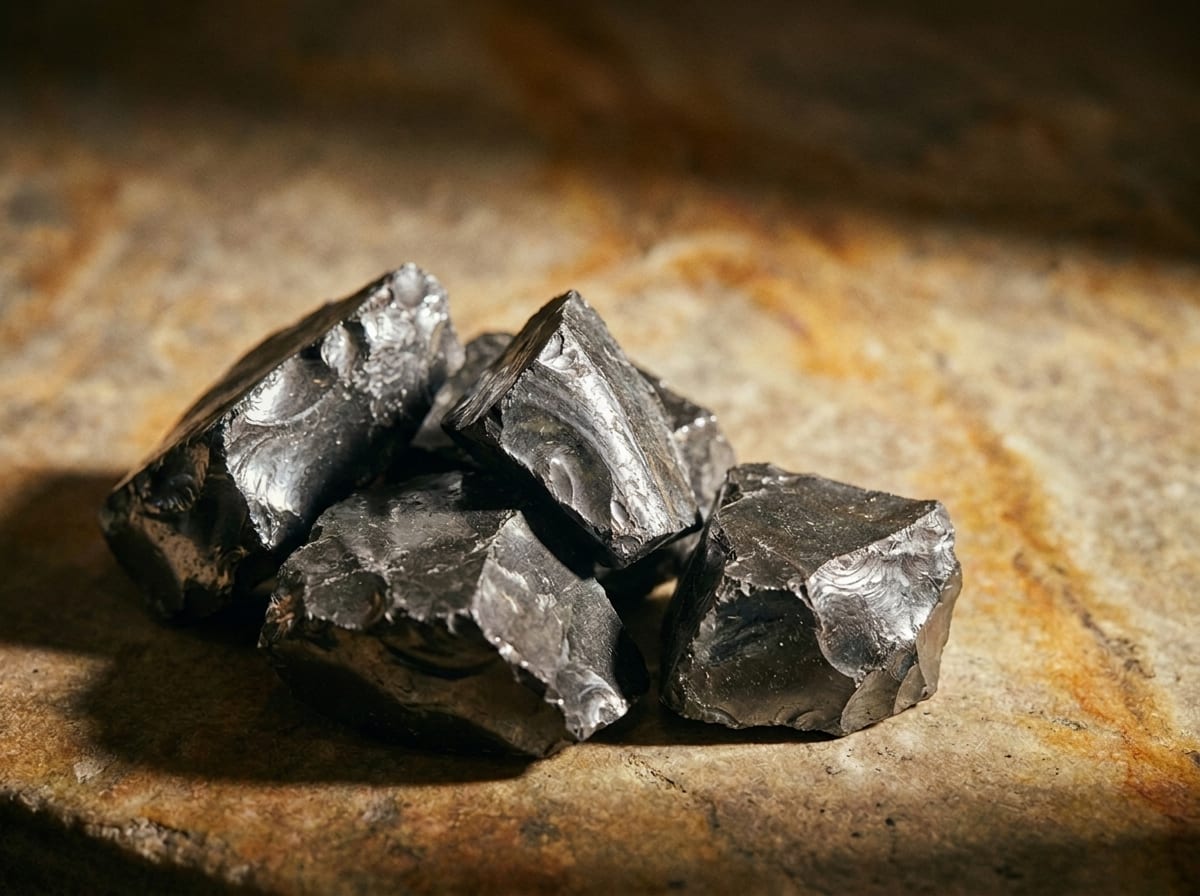
Two billion years old. In 1996, the Nobel Prize was awarded for its components.
Two billion years old. In 1996, the Nobel Prize was awarded for its components.
| Origin | Age | carbon content | What it binds |
|---|---|---|---|
| Karelia, north-western Russia |
approximately 2 billion years
|
95 to 98%
|
free radicals, organochlorine compounds, excess metals
|
Precious shungite
What is that?
Precious shungite is a carbon-based rock found almost exclusively in a single region of the world: in Karelia in north-western Russia, around Lake Onega. The deposits are thought to be around two billion years old, making them among the oldest carbon deposits on our planet.
What distinguishes noble shungite from ordinary shungite is its purity. Whilst ordinary shungite consists of around 30 to 60% carbon, noble shungite reaches levels of 95 to 98%. The remainder consists of silicates and trace minerals.
The fact that this rock plays any role at all in water treatment today is down to a discovery that earned the scientific community a Nobel Prize in 1996. More on this in the next section.
How it works in water
Precious shungite contains fullerenes. These are spherical carbon molecules that were first synthesised in 1985. Their discoverers, Robert Curl, Harald Kroto and Richard Smalley, were awarded the Nobel Prize in Chemistry for their work. The best-known fullerene is C₆₀, a molecule consisting of 60 carbon atoms, whose shape resembles a football. Architects are familiar with this geometry from Buckminster Fuller’s geodesic domes, hence the name.
The surprise came later: these molecules exist not only in the laboratory, but also in nature. Edelschungite is one of the few known occurrences.
In water, fullerenes have two effects that are crucial to drinking water quality:
They bind free radicals. In research, fullerenes are regarded as ‘radical scavengers’. They absorb reactive oxygen species and neutralise them. This is also why they are now used in anti-ageing creams and are being researched in medicine.
They have a catalytic effect. In the filter, fullerenes accelerate the oxidation of chemical compounds that have no place in tap water. These include organochlorine compounds, nitrates, nitrites and excess amounts of iron, manganese or copper. Edelschungite clarifies the water visually and renders it tasteless and odourless.
Important: Precious shungite does not even react chemically with boiling acid. It releases nothing into the water that does not belong there. This is precisely what makes it such a reliable filter medium.
The story behind it
Long before anyone had heard of the word ‘fullerene’, the people of Karelia were aware of the effects of the water that flowed through shungite. In 1714, a farmer named Ivan Reboev discovered an iron-rich spring near the shungite deposits. Shortly afterwards, Peter the Great made the place Russia’s first spa resort and named the water ‘Martial Water’ after the Roman god of war, Mars.
The Tsar travelled there himself four times, between 1719 and 1724. The springs are still in use today. What was once empirical knowledge can now be explained at a molecular level.
Written by Daniel Knoch