Four grams. Six thousand four hundred square metres. A football pitch.
Four grams. Six thousand four hundred square metres. A football pitch.
| Raw material | Inner surface | What binds them | Quantity in Kini cartridge |
|---|---|---|---|
| sustainably certified coconut shells |
up to 1,500 m² per gram
|
Chlorine, pesticides, hormone and drug residues
|
170 grams
|
active
What is that?
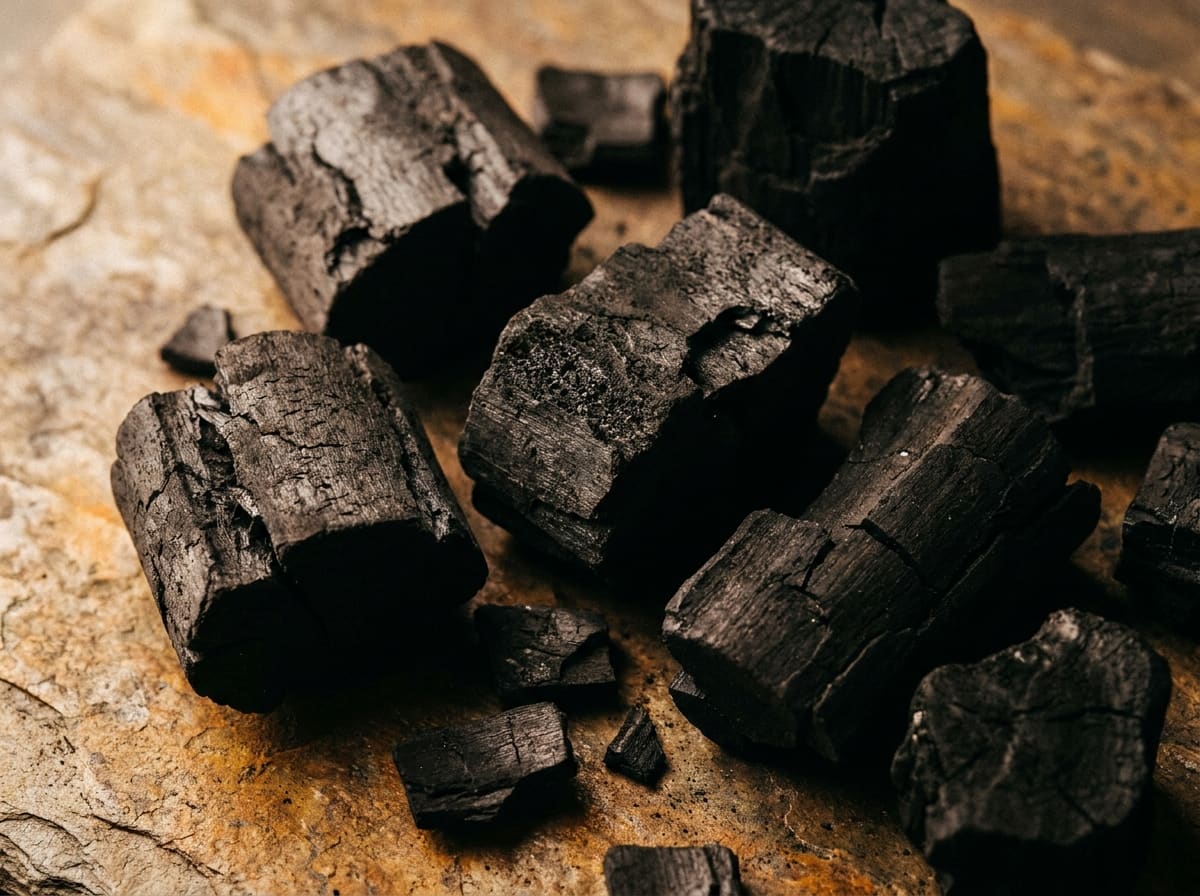
Activated carbon is produced when plant material is carbonised under very high heat and in the absence of oxygen, and is then ‘activated’ using steam. During this activation process, the steam molecules create millions of tiny pores in the material. What remains is a sponge made of pure carbon, which has an immense internal surface area.
We use only activated carbon made from coconut shells. Unlike activated carbon made from coal or wood, it has a particularly dense microporous structure. It is precisely these micropores that are crucial when it comes to binding small organic molecules from the water, such as chlorine compounds or pesticide residues.
The coconut shells are a by-product of the coconut harvest. Instead of burning or disposing of them, we give them a second purpose.
How it works in water
The effect is based on a principle that chemists call adsorption. Pollutant molecules attach themselves to the walls of the pores and remain there. Unlike in absorption, they are not absorbed into the material but are held on the surface. This is also why surface area is so crucial.
Four grams of this activated carbon have an internal surface area of around 6,400 square metres. That is the area of an entire football pitch. A Kini cartridge contains 170 grams. This results in an adsorbable surface area capable of removing even stubborn trace substances from the water.
What activated carbon removes from the water:
Chlorine and chlorine by-products. These are the substances responsible for the typical taste of tap water. They are used for disinfection, but do not belong in a glass of drinking water.
Pesticides and herbicides. Residues from agriculture that can spread via groundwater. Studies show adsorption rates of 80 to 85% for common plant protection products.
Hormone and medication residues. These trace substances enter the water cycle via wastewater. Municipal waterworks only filter them out to a limited extent. Activated carbon binds them reliably.
Organic compounds. These include volatile organic compounds such as solvent residues or trihalomethanes, a by-product of chlorination.
The story behind it
Activated carbon is one of the oldest filter media in existence. Charred wood was already being used for water purification in ancient Egypt. The real breakthrough came in the 19th century, when scientists realised that it is not the carbon itself that is effective, but its surface.
Coconut shells were only discovered as a raw material in the 20th century. Today, they are the standard when it comes to the finest and purest form of activated carbon for drinking water. They combine two things that rarely go hand in hand: maximum effectiveness and a consistently renewable raw material.
Written by Daniel Knoch