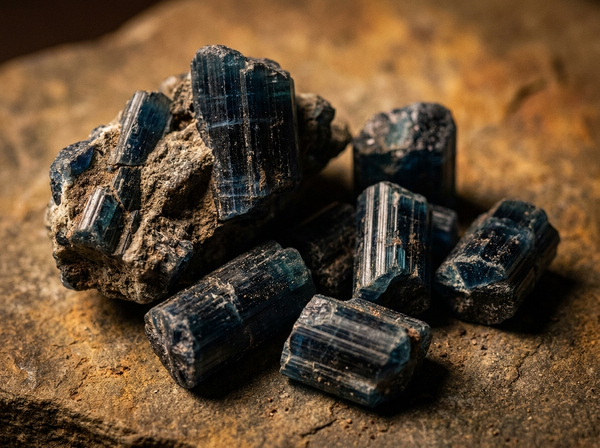
Tourmaline: the ‘electric’ stone in our ceramics
Not just filtered. Spring water quality.
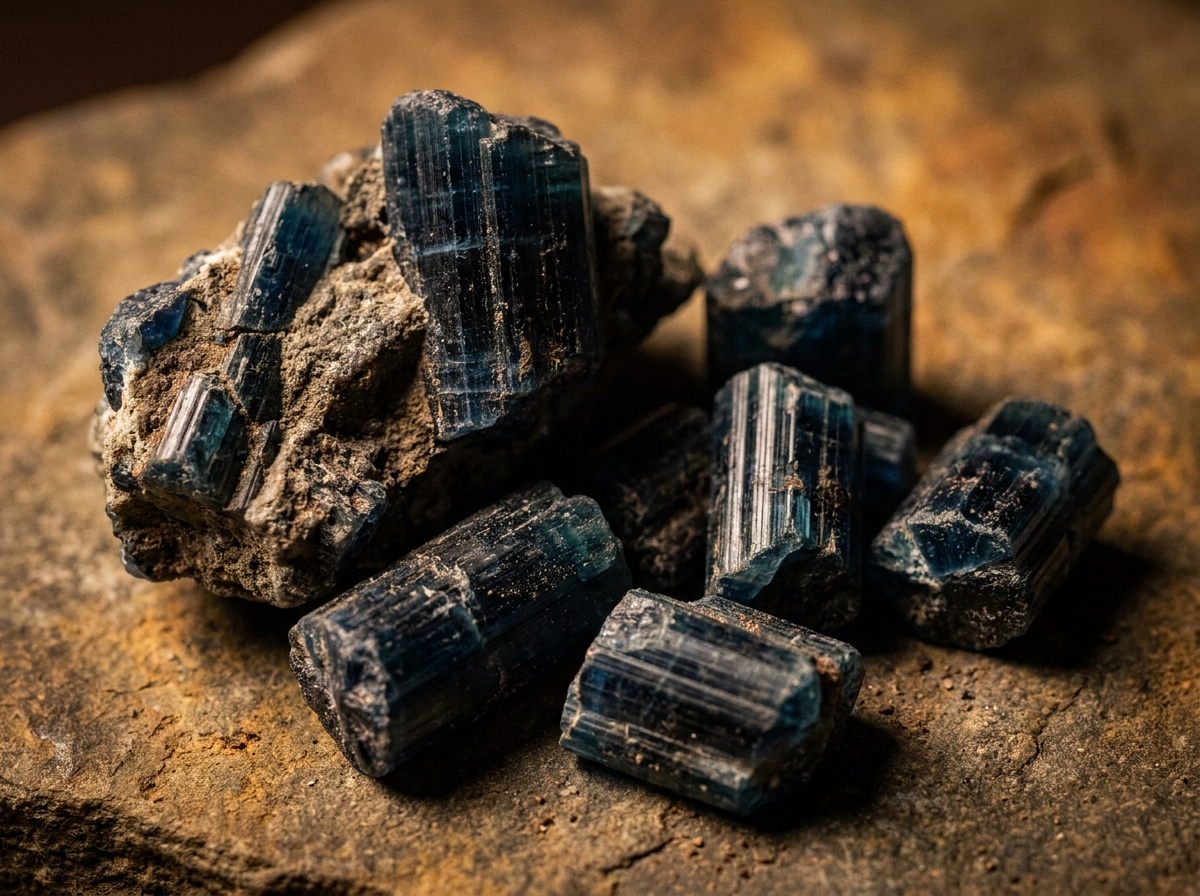
- Tourmaline is a boron-containing silicate mineral. When a crystal is heated or compressed, an electrical voltage is generated at its ends.
- Tourmaline ceramic is found in every MAUNAWAI water filter, finely ground into small ceramic beads, together with over 20 other mineral ceramics.
- There is no proven effect of tourmaline ceramics on water. We use them out of conviction and are open about this.
What is tourmaline?
Tourmaline is not a single mineral, but a group of closely related crystals. Mineralogists classify them as ring silicates. All tourmalines contain boron, as well as iron, magnesium, sodium, lithium or aluminium, depending on the variety. This explains their wide range of colours, from black through green and blue to pink. The most common variety is black, iron-rich schorl.
Why is tourmaline called the ‘electric stone’?
The tourmaline crystal has a different structure at each end. When its temperature changes, the charges in the lattice shift, creating a voltage at the ends. This is known as pyroelectricity. The same thing happens under pressure; this is known as piezoelectricity.
The voltage is only generated whilst the temperature or pressure is changing. If both remain constant, it balances out again.
The stone that attracts ash
The name originates from Sinhala, the language of Sri Lanka. Traders there referred to colourful, unspecified gemstones as ‘toramalli’. Dutch merchants brought the stones to Europe from Ceylon – now Sri Lanka – around 1700. A report from 1707 recounts that a heated tourmaline attracted ash. The Dutch therefore called it ‘Aschentrekker’, meaning ‘ash-puller’. In 1747, Carl von Linné described an ‘electric stone’ from Ceylon in the preface to his *Flora Zeylanica*. In 1756, the physicist Franz Aepinus demonstrated that electricity was responsible for this attraction. The term ‘pyroelectricity’ was coined by David Brewster in 1824.
Source: GIA, ‘Tourmaline History and Lore’ (English)
Where is the tourmaline in the filter?
The cartridge contains several layers. Pollutants are retained by other filter media, such as activated carbon made from coconut shells. The tourmaline ceramic lies in between: finely ground tourmaline, fired with other minerals into solid spheres. It does not filter.
Two levels: what we can prove and what we believe
What is proven
- Tourmaline is pyroelectric and piezoelectric. This is basic mineralogical knowledge.
- We provide evidence of what our filters measurably retain through test data, laboratory results and standards, such as the PFAS reduction in Kini and PiTec 2in1. This evidence applies to the entire filter, not the tourmaline ceramic alone.
What has not been proven
Whether the tourmaline ceramic alters the water has not been proven. We do not have a test that would demonstrate this. We use it nonetheless because it has been part of our formula for decades and we are convinced of its benefits. This is our conviction, not a measured value. We do not promise any effect on the body.
Frequently Asked Questions
Written by Daniel Knoch