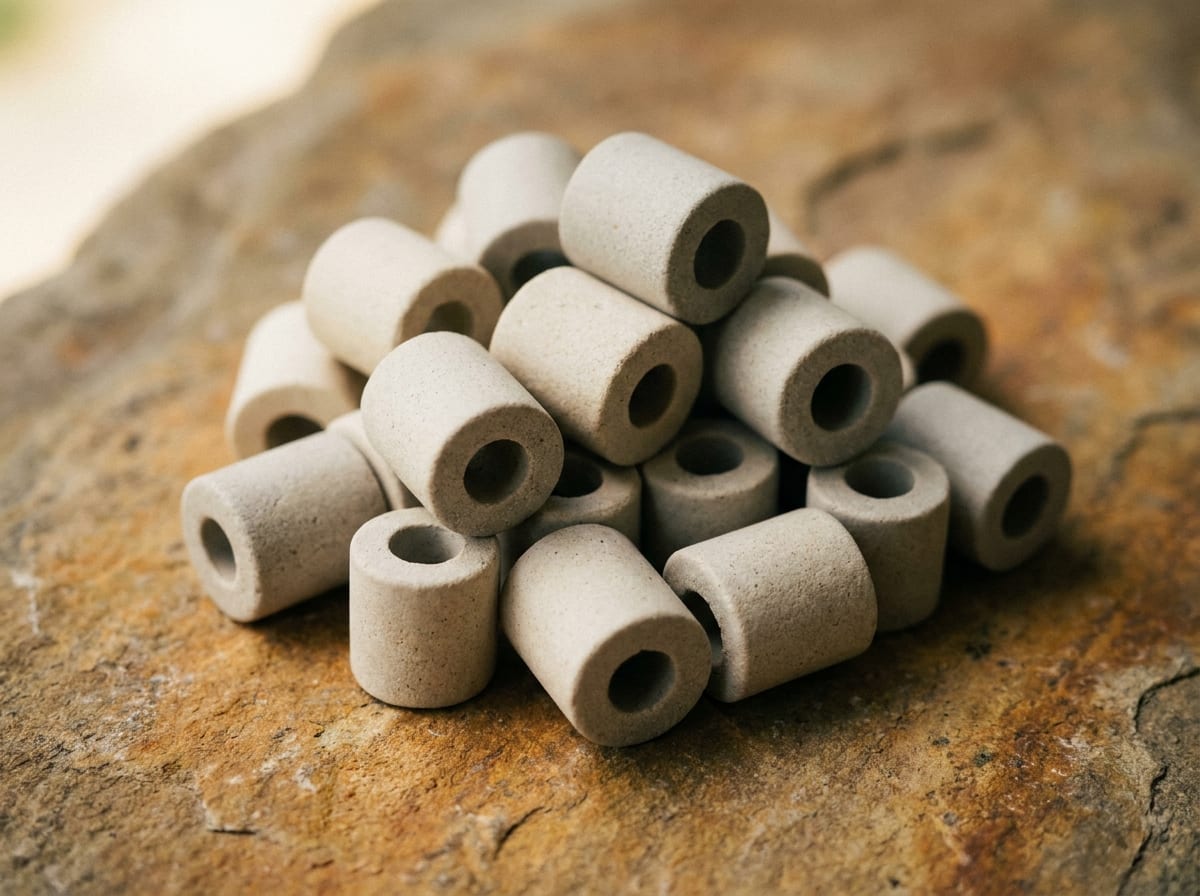
Over eighty microorganisms, fired into ceramic. Like a culture in yoghurt, but for water.
Over eighty microorganisms, fired into ceramic. Like a culture in yoghurt, but for water.
| Developer | Components | Effect in water | Types of bacteria in clean drinking water |
|---|---|---|---|
| Prof. Teruo Higa, University of the Ryukyus (Okinawa), 1980 |
approx. 80 key microbes
|
restores the microbial balance
|
up to 2,000
|
|
|
|
|
EM Ceramics
What is that?
EM stands for ‘Effective Microorganisms’. It consists of a mixed culture of around 80 naturally occurring microbes, including lactic acid bacteria, yeasts and photosynthetic bacteria. They all belong to the group known as regenerative microorganisms. Unlike decomposing or neutral microbes, they actively promote the stability of their environment.
This mixture is blended with clay, fermented and then fired at high temperatures to form a ceramic. What remains are not the living bacteria themselves, but their “imprint” in the material: metabolic products and structural patterns that continue to exert their effect in water. It is precisely this firing process that makes EM ceramics safe for use with drinking water.
How it works in water
EM ceramics act as a biological activator. They create an environment in which beneficial microorganisms thrive and harmful pathogens find it harder to establish themselves. This works through two mechanisms:
Stabilisation of microbial diversity. Clean drinking water contains up to 2,000 species of bacteria. These are not contaminants, but specialists that thrive on extremely few nutrients and ensure that the water remains stable. EM ceramics support precisely this bacterial diversity, rather than suppressing it.
Shifting the environment to an alkaline state. Water from MAUNAWAI systems is slightly alkaline. In an alkaline environment with an energy surplus, problematic bacteria cannot multiply. They compete with the intact water flora and lose out.
The story behind it
EM technology was pioneered by Professor Teruo Higa of Ryukyus University in Okinawa, Japan. He developed the mixed culture of effective microorganisms in the 1980s, originally for organic farming. Higa was looking for a way to regenerate soil without using chemical fertilisers.
This agricultural approach soon gave rise to a whole range of applications. EM ceramics were developed to incorporate the action of the microorganisms into solid materials, from building components to water pipes. Today, they are used in the food industry as well as in water treatment.
In our filters, EM ceramics work in conjunction with the other five materials. It acts where the other layers do not: not on substances, but on microorganisms.
Written by Daniel Knoch